
The number of coffee consignments arriving in the UK edged higher in the first quarter of 2026, even as the price of the beans inside them was setting records. It is a small move in the trade data, but it points at a much larger risk for the businesses doing the buying.
New analysis of UK coffee import data from HM Revenue & Customs shows 1,384 separate import instances in Q1 2025 and 1,428 in Q1 2026, a rise of 44, or 3.2%. Each instance is a single consignment recorded as it crosses the border rather than a measure of weight or value, so the figure tracks how often businesses were importing, not how much they landed. The increase was steady, showing up across all three months of the quarter rather than in a single spike.
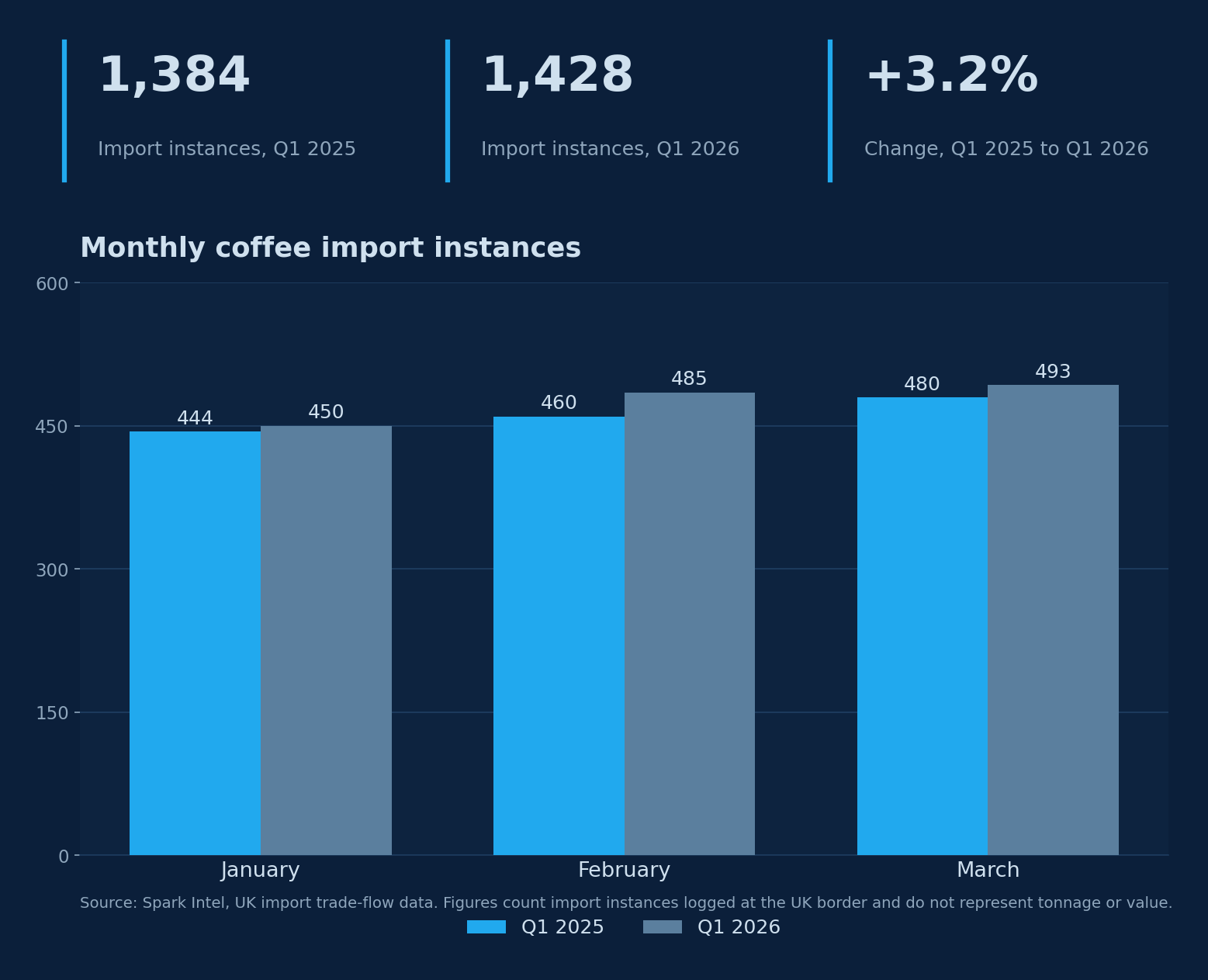
That steady rise sits against one of the most turbulent runs the global coffee market has seen in a decade. Arabica futures, the benchmark behind much of the world price, climbed through 2024 and touched a record of around 4.41 US dollars a pound in February 2025, in the middle of the quarter being compared. Behind it was a stack of supply shocks: the worst drought in roughly 70 years across Brazil, the largest grower; drought and then flooding in Vietnam, the robusta heavyweight; and global stocks run down to multi-year lows. Disruption on the Asia-to-Europe shipping lanes did the rest.
By early 2026 prices had come off the peak as the next harvest looked healthier, but they stayed well above their five-year average. Read against that, a small rise in import instances is more telling than it looks. Coffee demand does not fold easily when prices climb, the country keeps drinking it, so the beans keep coming. If anything, importers facing an expensive and unpredictable market tend to spread their buying across more, smaller consignments rather than commit to large volumes at a single price, which nudges the number of import events up rather than down. It is a sign of demand holding firm, not of businesses shrugging off the cost.
What it means for GBP/USD
Here is the part that matters for anyone settling those invoices. Coffee trades in US dollars, so a UK roaster or importer carries two risks at once: the dollar price of the beans, set by weather thousands of miles away, and the GBP/USD rate on the day they pay. The two rarely move together, and either can move against a buyer. A shipment agreed at one rate and paid for weeks later at another can cost materially more in pounds even if the dollar price has not budged. And with more consignments crossing the border rather than fewer, there are simply more moments at which that rate can move against a buyer.
Paying at spot hands a business the full force of both moves at once. In a calm market that is a manageable habit; in a market like this one, it is the difference between a planned-for order and a loss-making one by the time the invoice falls due. And the exposure is not confined to coffee. Any importer paying dollar or euro suppliers in a volatile stretch faces the same maths, which is why so many of the businesses we speak to treat currency as a cost to be managed rather than a number to be discovered after the fact.
Taking the currency out of the equation
This is what hedging is built for. A forward contract fixes the exchange rate today for a payment due in three, six or twelve months, turning an unknown future cost into a known one so margins can be planned. Options and more structured approaches can protect against an adverse move while leaving room to benefit from a favourable one. None of this touches the commodity price, and no hedge makes a business immune to a market, but it removes the currency guess, which for most importers is the larger and more avoidable of the two unknowns.
The route matters as much as the tool. Doing nothing leaves the full swing on the table. A high-street bank will usually transact the deal, but often at standard rates and with little steer on how much to cover, when, or with which instrument. A named dealer works the other way round, building the cover around a business's real payment calendar and exposure, and staying close as the market moves. For an importer whose input costs are already being thrown around by drought and freight, that is one of the few variables genuinely within their control, and the kind of exposure our dealers help clients manage every day.
The import figures in this article are based on UK overseas trade statistics published by HM Revenue & Customs and analysed by Spark Intel, the research arm of Spark Finance, comparing the first quarter of 2025 with the first quarter of 2026. The figures cover coffee across its main commodity codes, including roasted, unroasted and decaffeinated. An import instance is a single consignment logged as goods cross the UK border and does not represent tonnage or value. Coffee price references reflect widely reported global benchmark movements over the period.


